
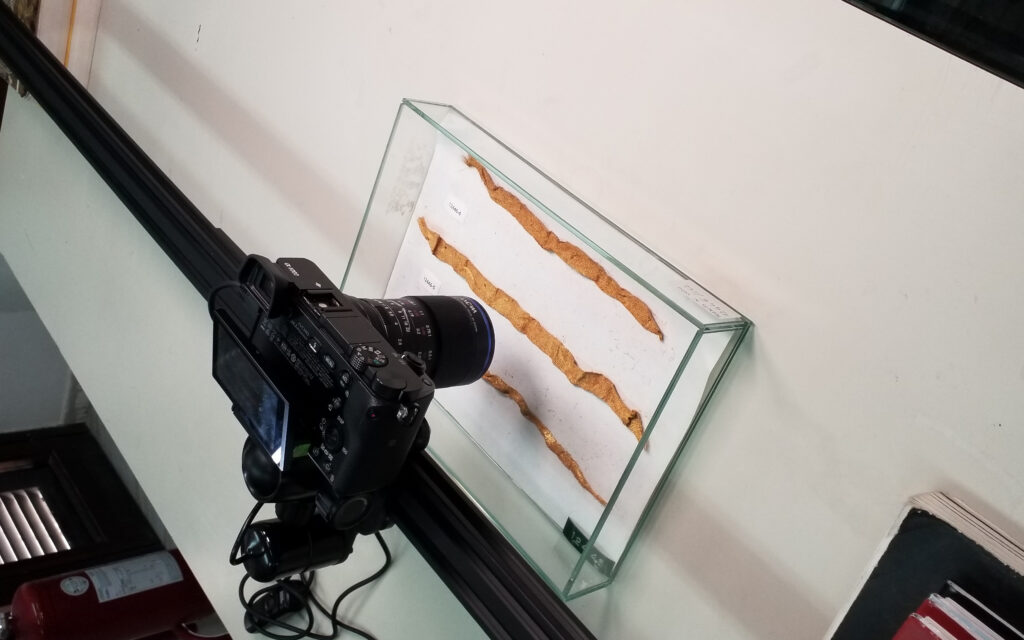
This use case focuses on the largest collection of Roman-era textiles preserved in Italy and Europe, over 350 textile fragments and 15 gold woven ribbons from Pompeii, complemented by 45 human plaster casts bearing rare three-dimensional imprints of garments and textile structures. Together, these collections offer an exceptional window into textile technology, raw materials, and fashion at the heart of the Roman Empire in the 1st century CE.
Collection: Textiles from Pompeii Archaeological Park
It consists of mineralised, carbonised and gold textiles and it is the largest collection of Roman time (1st c. CE) preserved in Italy and Europe [third-party POM]. The most important aspect is that the textiles are found in a site at the centre of the Roman Empire, and this is a unique perspective and window to study Roman textile technology and fashion; shedding light on raw materials used for finishing textiles, technical and cultural traditions that have been originating the textile materials of the Vesuvian area, as well as tracing technological transfers, the hybridization of techniques and vice-versa the integration of different raw materials (e.g., silk) favoured by cultural and commercial interaction. In this perspective, the textile remains found in the ancient sites of Pompeii offer exceptional information potential by exhibiting numerous textiles remains which are highly representative of dynamic, multicultural towns of the Roman Empire.
Collection: Imprints from Pompeii Archaeological Park
At Pompeii [third-part POM], imprints have been preserved using plaster to fill in the voids left by soft tissues in the ground during excavation. Bodies, garments and accessories have been brought again to materiality in their original volume and shapes. The human plaster casts from Pompeii are thus positive imprints of bodies with fine details of textile structures and garments, which can be studied and investigated as actual three-dimensional textile remains. Therefore, this collection should be considered complementary to that composed of the actual textile remains for three reasons: 1) it integrates the dataset related to textile structures and technology used in Pompeii during the 1st c. CE; 2) enables comparisons between garments and the type of textile weaves and quality, allowing to attribute the lost function of the extant textile artefacts; 3) enables to open a privileged window on the fashion and the way of dressing at the end of the first century in the centre of the Roman empire. By preserving both textile structures and the form of the garments the plaster casts of Pompeii exceptionally preserve an exceptional part of the ancient textile heritage, that is usually lost at Mediterranean latitudes.
Responsible partner: Sapienza University of Rome
Items selected:
- Carbonised Textiles from Pompeii
- Gold Textiles from Pompeii
- Textile Imprints on Human Plaster Casts