
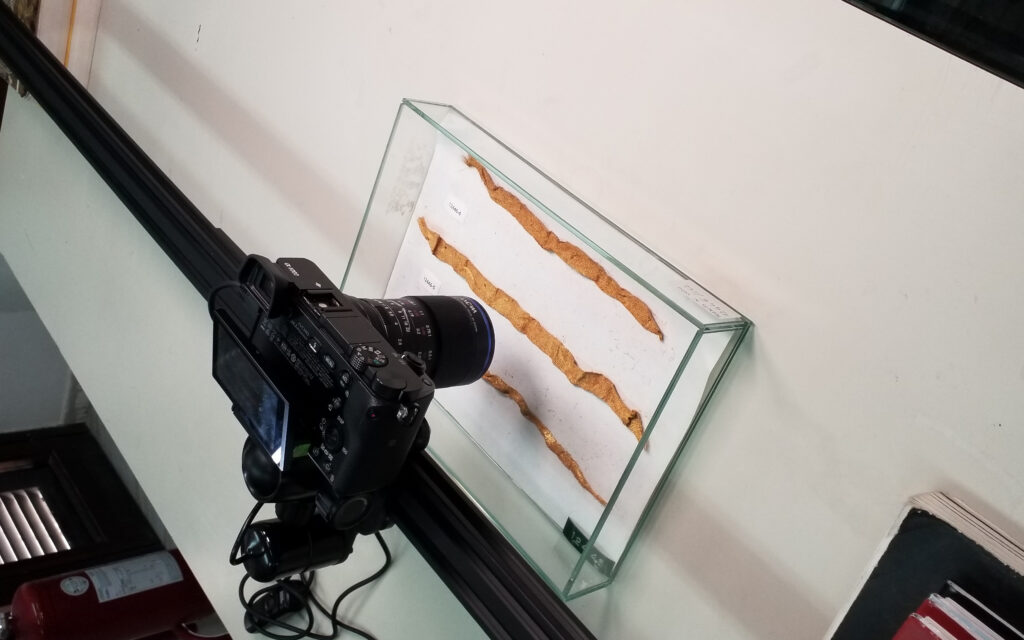
This use case investigates a unique collection of modern casts of clay sealings from Bronze Age Greece (c. 2650–1200 BCE), housed in the Corpus der minoischen und mykenischen Siegel (CMS) Archive in Heidelberg. These sealings, once used to secure containers, doors, and documents, carry the impressions of textiles and organic materials that were present during the sealing process. The preserved imprints offer indirect but valuable evidence of ancient textile technologies, materials, and handling techniques. Some even retain traces of knots, loops, and fine weave patterns, providing a rare glimpse into the tactile and practical world of Aegean administration. However, interpreting these impressions is far from simple. Challenges include their fragmentary and three-dimensional nature, the difficulty of identifying raw materials and production methods, and the limitations of traditional imaging tools. EXTaiLES addresses these challenges using high-resolution 3D scanning, photogrammetry, and Reflectance Transformation Imaging (RTI) to capture fine details in the casts. AI-powered analysis further supports the identification of textile types and techniques, revealing patterns of reuse and even gestures of individuals handling the materials. This approach opens new pathways for understanding everyday practices in the Bronze Age Aegean.
Collection: Corpus der minoischen und mykenischen Siegel (CMS), Heidelberg University [HED]
The evidence consists of a unique collection [third-party HED] of modern casts of clay sealings from Bronze Age archaeological sites in Greece (c. 2650–1200 BCE), stored in the Archive of the Corpus der minoischen und mykenischen Siegel (CMS) in Heidelberg. The BA Aegean societies commonly employed clay sealings in their daily administrative and storage procedures: lumps of clay authorised by one or more sealimpressions on one side, were attached directly to the objects subjected to sealing, such as room doors, chest sides, openings of various containers and documents. During the sealing process, textiles and organic products, such as threads, cords, leather thongs, sacks, mats, baskets, fabrics, left impressions on the undersides of these clay sealings or, in the case of hanging nodules, inside the lumps of clay. The CMS project has been dedicated to comprehensive documentation and publication of all Aegean seals and sealings, including documentation of several thousands of the undersides of clay sealings and nodules.
Responsible partner: The University of Warsaw