
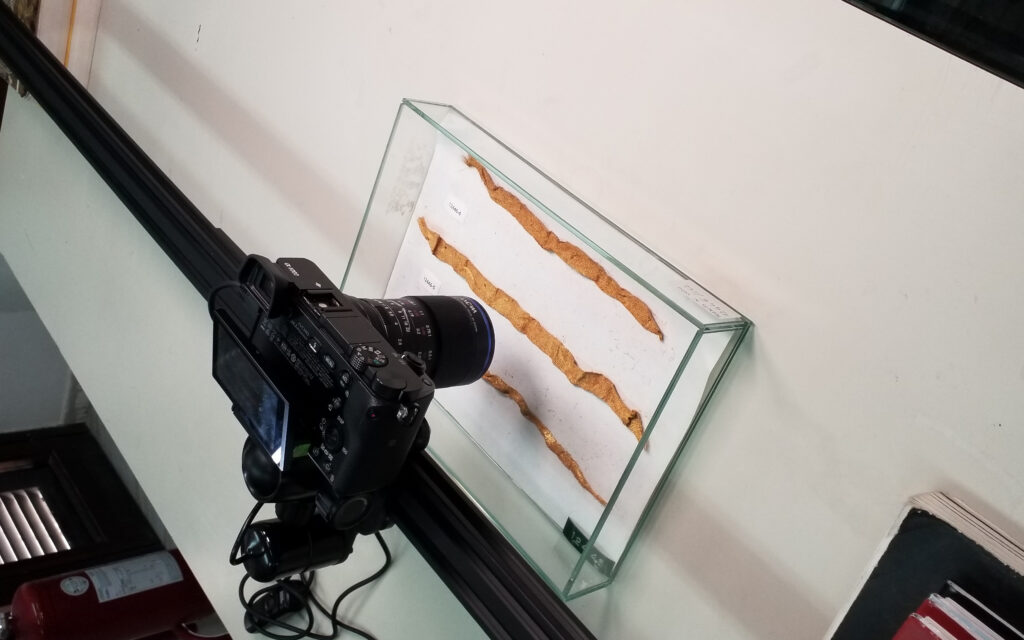
This use case focuses on one of the world’s most important collections of European lace and embroidery, housed at the Textile Museum St. Gallen. Spanning from the 14th to the 20th century, it includes delicate handmade pieces, machine embroidery from Switzerland’s textile industry, and iconic objects from the Iklé and Jacoby collections. Artefacts range from tiny lace fragments to complex costume components and oversized decorative textiles. Many are translucent, textured, and executed with fine monochrome threads, making them difficult to study, digitise, or interpret visually. TEXTaiLES applies Reflectance Transformation Imaging (RTI), 3D modelling, and automated scanning, including UAVs for large-scale objects, to digitally preserve structure, texture, and shape. These technologies enable rich online access, enhance research, and support long-term conservation of fragile and historically significant lace heritage.
Collection: Textile Museum St. Gallen
The museum holds one of the most important collections of textiles in Switzerland with approximately 56,000 objects, among which are Eastern Swiss embroideries, Egyptian textiles from late antiquity, European lace, embroideries and fabrics from the Middle Ages to the present day. The collection of historic lace is among the world’s most significant. It consists of about 6,500 samples of the most important centres of European lace production such as Italy, the Netherlands, Belgium, Germany and France, from the period spanning the 16th to early 20th century. Among the embroidery holdings are impressive European picture embroideries from the 14th to 16th century, while the handmade white embroidery as well as machine embroidered products trace the history of the embroidery industry of Eastern Switzerland in the 19th and 20th century. The famous collections of Leopold Iklé (1838–1922) and John Jacoby (1869–1953) laid the foundations for the museum’s collection are part of this study.
Responsible partner: Textile Museum St. Gallen